










// Atlas Technology
Atlas People Search: The Candidate Search Tool for Precise Hiring
Published: 02 June 2026,
10 min to read
Most recruitment agencies aren’t sitting on a shortage of candidates. They’re sitting on thousands of them, spread across a database that has grown steadily for years, filled with qualified candidates their recruiters have sourced, screened, placed, and spoken to. It’s being able to find exactly the right person on demand, without already knowing where to look during the hiring process. Without a candidate search tool capable of surfacing the right talent quickly, even the strongest candidate databases become difficult to use effectively.
When a search takes too long, returns the wrong results, or can’t be specific enough to surface the precise profile a recruiter has in mind, the database stops being an asset and starts being a liability. Recruiters abandon it and return to other recruiting tools or to sourcing candidates via social media platforms. Candidates who were a perfect fit for a role stayed hidden. And the agency pays to source top talent it already has.
The answer most teams and hiring managers reach for is another recruiting tool. A better Boolean search plugin, a smarter AI candidate sourcing add-on, a new database layer. The instinct is understandable, but the diagnosis is wrong.
More candidate search tools don’t fix poor search capability during the hiring process. They add complexity, fragment your data, and create inconsistency across the team. What changes outcomes is having one search capability specific enough to find exactly who your recruiters are looking for, every time.
Is Your Recruitment Database Working Against You?
The value of a recruitment database is not its size. It is the proportion of it that you can actually access with precision. A database of ten thousand potential candidates is only useful if a recruiter can search it specifically enough to find the one person they need for a job opening. When the search experience is generic, broad, or clunky, the database becomes a historical record rather than a live talent pool.
This plays out in predictable ways at the agency level. Recruiters default to sourcing new candidates rather than re-engaging existing ones because the CRM can’t provide a sufficiently specific answer quickly enough. Senior recruiters who know the database well get results by relying on memory and instinct. Junior recruiters who don’t, don’t.
Candidate searches are inconsistent across the team because precision depends on the individual, not the platform. And the longer a job seeker sits in the database without being surfaced, the more likely they’ve been forgotten entirely.
The compounding cost is high. Every placement that could have come from the existing database but instead required fresh talent sourcing represents time spent, fees paid, and margin lost. The database was supposed to reduce that overhead. Search that isn’t specific enough means it rarely does.
Can Smarter Candidate Sourcing Tools Actually Close That Gap?
The question worth asking isn’t whether your talent acquisition team has enough candidate sourcing tools. It’s whether the search experience inside your recruitment CRM is specific enough that your recruiters trust it to find exactly who they need during the recruiting process. That trust only comes when the tool can understand what a recruiter is actually looking for. It also needs to return results that are precise enough to act on immediately.
Most recruitment agency software still requires recruiters to translate a specific person they have in mind into generic filter logic. Role, location, seniority, skills: each selected individually, in the right combination, before any results appear. That process loses specificity at every step. By the time the search runs, it no longer reflects the nuanced profile the recruiter was thinking of. It reflects whatever the filters allow.
AI candidate search changes that relationship entirely. When a recruiter can describe the specific person they’re looking for in plain language, the way they’d brief a colleague, the search process becomes much more intuitive. The system then translates that description into a precise search, ensuring nothing is lost in translation. The result is a shortlist that reflects exactly what was asked for, drawn from everything the team already has.
What Is Candidate Search and What Tools Are Recruiters Using to Achieve It?
Candidate search is the process recruiters use to find suitable candidates for a role, either from an existing internal database or by sourcing new people externally. Most recruiters currently rely on multiple sources to find candidates. Their applicant tracking system or CRM is used for filter-based searches across existing contacts, while social media platforms, job boards, and CV databases are used to source passive and active talent. They also use Boolean search techniques to refine results across any of these platforms and sourcing plugins to enrich profiles and find contact details.
An applicant tracking system (ATS) serves as the backbone of recruitment operations, managing candidate data from application to job offer. The common thread across all of these is that they are either external, meaning they bypass the relationships and data the agency has already built. Alternatively, they require recruiters to translate a specific person they have in mind into structured filter logic, losing nuance at every step.
Neither approach is a reliable foundation for finding exactly the right person, fast. That is the gap Atlas People Search is built to close.
What Is the Atlas People Search Feature?
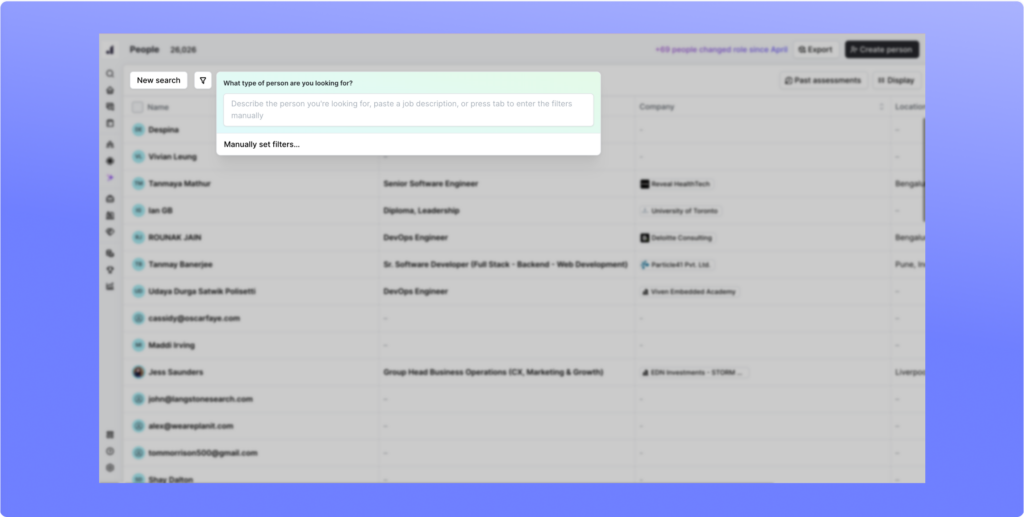
Atlas People Search is a candidate search tool built into the Atlas CRMx that helps recruiters find the right person from their existing database, fast. Instead of relying on rigid filters or switching between external platforms, recruiters can describe exactly who they are looking for in plain language. Atlas – the Recruitment Platform then builds the search for them, drawing from every candidate the team has ever sourced, placed, or spoken to.
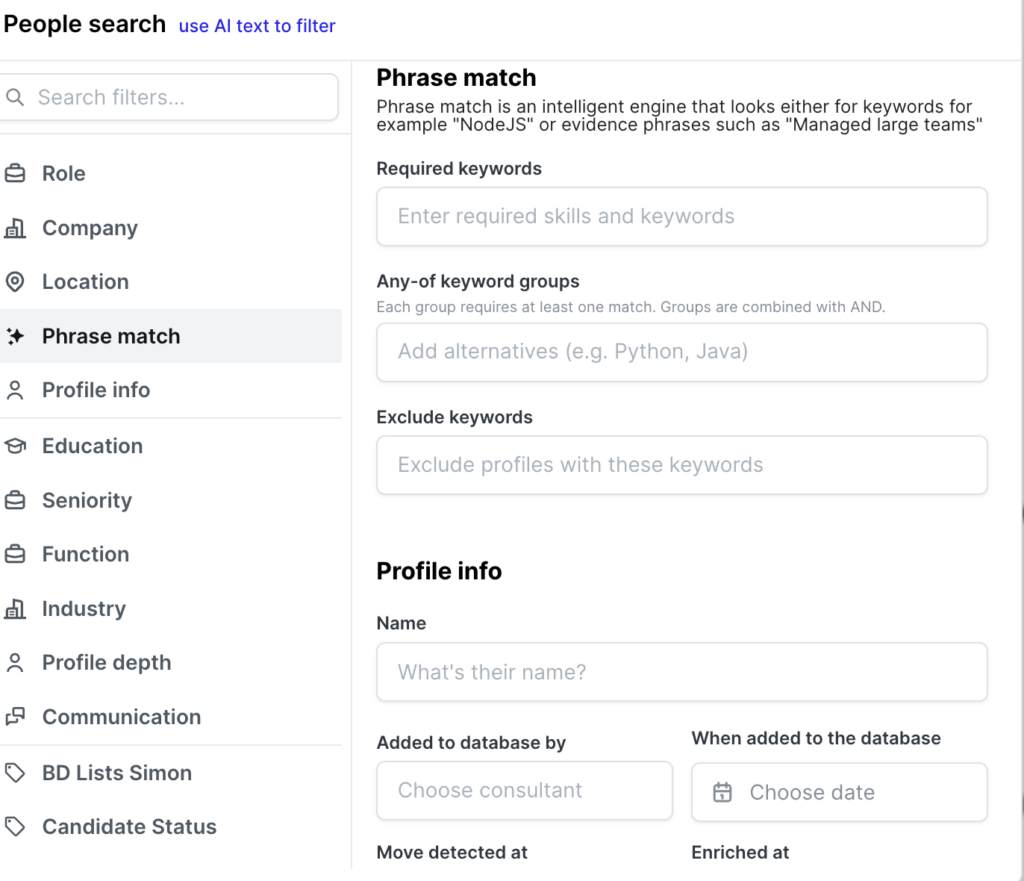
Phrase Match gives recruiters precise control over what Atlas – the Recruitment Platform looks for inside candidate profiles. This ensures every search operates within the boundaries and criteria defined by the recruiter. The result is a shortlist of candidates who actually qualify, without the noise, without the manual review, and without having to rebuild the same search twice.
By resurfacing relevant candidates already in the database, recruiters can increase candidate engagement and reconnect with passive candidates they have previously spoken to for other opportunities. This also helps teams move qualified candidates to interview scheduling faster, accelerating the hiring process.
It also helps recruiters maximize the value of their existing network while reducing sourcing time and accelerating hiring outcomes. As a result, hiring managers receive a stronger, more relevant shortlist of candidates and can make decisions with greater confidence.
How Does Atlas People Search Help Recruiters Find the Best Candidates in Their Database?
Describe who you are looking for, and Atlas – the Recruitment Platform turns those instructions into a set of ready-to-use filters. Review what it created, remove anything that does not fit, and adjust before running. Searches can also be repeated quickly without rebuilding them from scratch, giving the team full visibility into how the recruitment database is being searched at any point.
Atlas People Search gives recruiters two ways to find the best candidates, so the search always fits the brief, not the other way around.
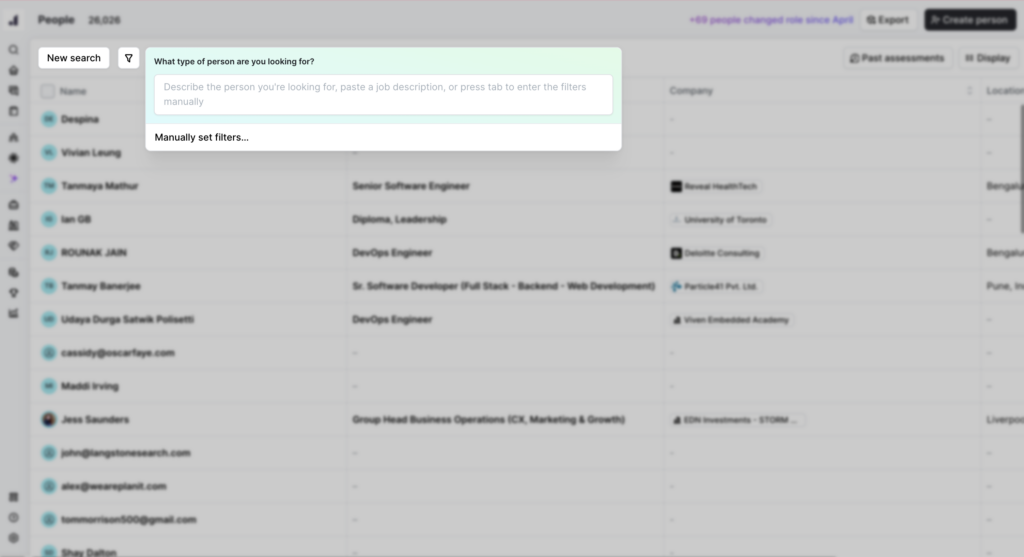
1) AI Text to Search
A recruiter types a description, pastes a job description, or writes out the profile they have in mind, and Atlas returns the closest matches across the entire database automatically. For example, a recruiter looking for a software engineer with five years of experience and a background in React.js can simply type that description into Atlas. People Search then builds the search automatically and surfaces the most relevant candidates instantly.
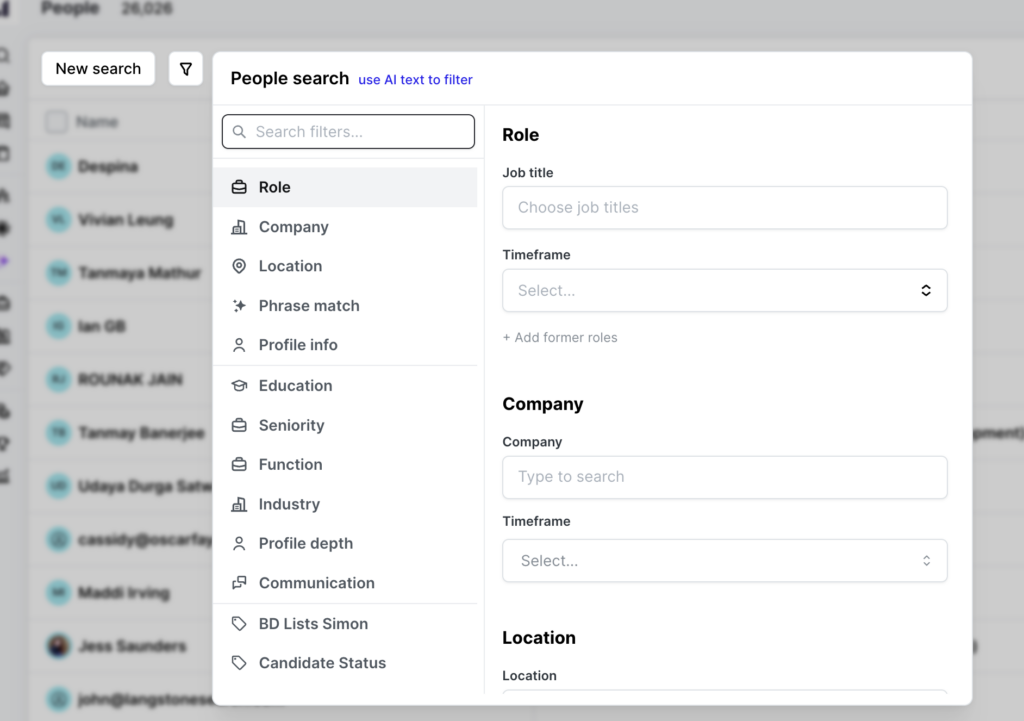
2) Manual Filter Search
Recruiters build queries by selecting criteria like role, location, seniority, company, and education through an open filter menu, with full control over every parameter. The same React.js search could be built manually by setting the role, years of experience, and adding React.js as a required keyword.
Both methods support granular keyword logic. Recruiters can require specific skills or experience phrases that every result must include. They can also create alternative keyword groups where at least one match is needed and exclude criteria that would make a candidate the wrong fit.
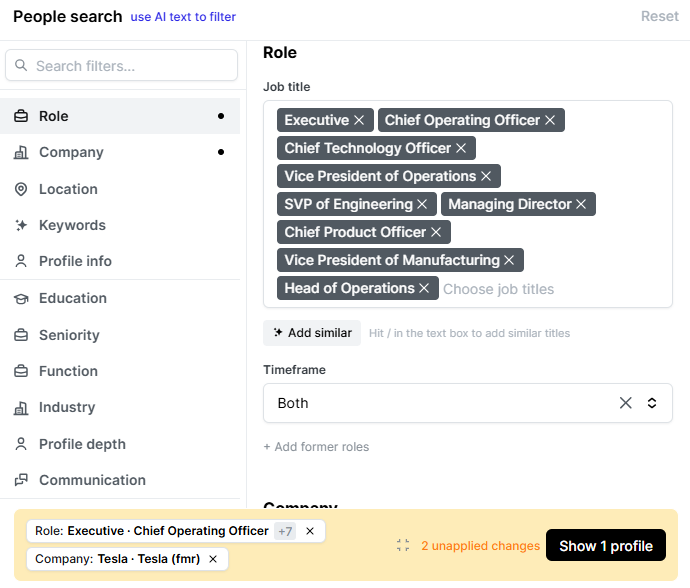
For searches that require an even deeper level of precision, recruiters can activate deep candidate assessment. Atlas then works through the entire database and explains exactly why each candidate fits the brief. This makes Atlas People Search more than a candidate search tool; it becomes a decision-support system that gives recruiters the context they need to move quickly and confidently.
Frequently Asked Questions (FAQs) about Candidate Search Tools
The most important factor is specificity: whether the tool is precise enough that recruiters trust it to find exactly who they’re looking for. Agencies should prioritise tools that support natural language input, deliver results with clear rationale, and give recruiters granular control over what the search includes and excludes.
Most agencies underuse the databases they already have, not because the top candidates aren’t there, but because the search isn’t specific enough to reliably surface the right ones. When search precision improves, recruiters default to the internal database first, reducing sourcing costs and shortening time to shortlist.
Most recruitment database searches require recruiters to know exactly what filters to apply before they can start, which puts the burden of precision on the person rather than the platform. Atlas works the other way around: describe who you’re looking for in plain language, and the system builds the search for you, with the option to set filters manually if preferred.
Atlas resolves context-heavy language, such as references to funding stages, career milestones, or seniority levels, into concrete search criteria automatically. Recruiters can review the filters generated before running the search and adjust anything that doesn’t look right.
Yes. People Search runs across the entire shared database, including every great candidate the team has ever sourced, placed, or spoken to. That shared scope is what makes it a genuine candidate sourcing tool rather than a personal search filter.
Finding the Right Candidate Through Your Applicant Tracking System
Modern AI sourcing platforms can deliver dramatically higher efficiency than manual search. They help recruiters identify and connect with qualified candidates based on career progression and transferable expertise.
Hiring teams that consistently place faster and source smarter are not the ones with the most candidate search tools. They are the ones whose recruiters can find exactly who they’re looking for in their existing database, without friction. That capability is built on one thing: a search experience specific enough to return the right person, with the right context, every time.
Most tools and recruiting software rarely deliver that. While many candidate search tools promise better sourcing outcomes, they often add complexity without improving precision. One well-built search capability, integrated into the platform where your candidate data already lives and precise enough to find anyone in it, does. The right AI recruiting software removes the gap between the specific person a recruiter has in mind and the candidate the database can surface, making every sourcing decision faster and every shortlist stronger.
That is what Atlas – the Recruitment Platform is built to deliver. A CRMx powered by agentic AI that removes the admin burden from recruitment workflows, starting with the search that should have been this specific from the beginning.

You may also like
See all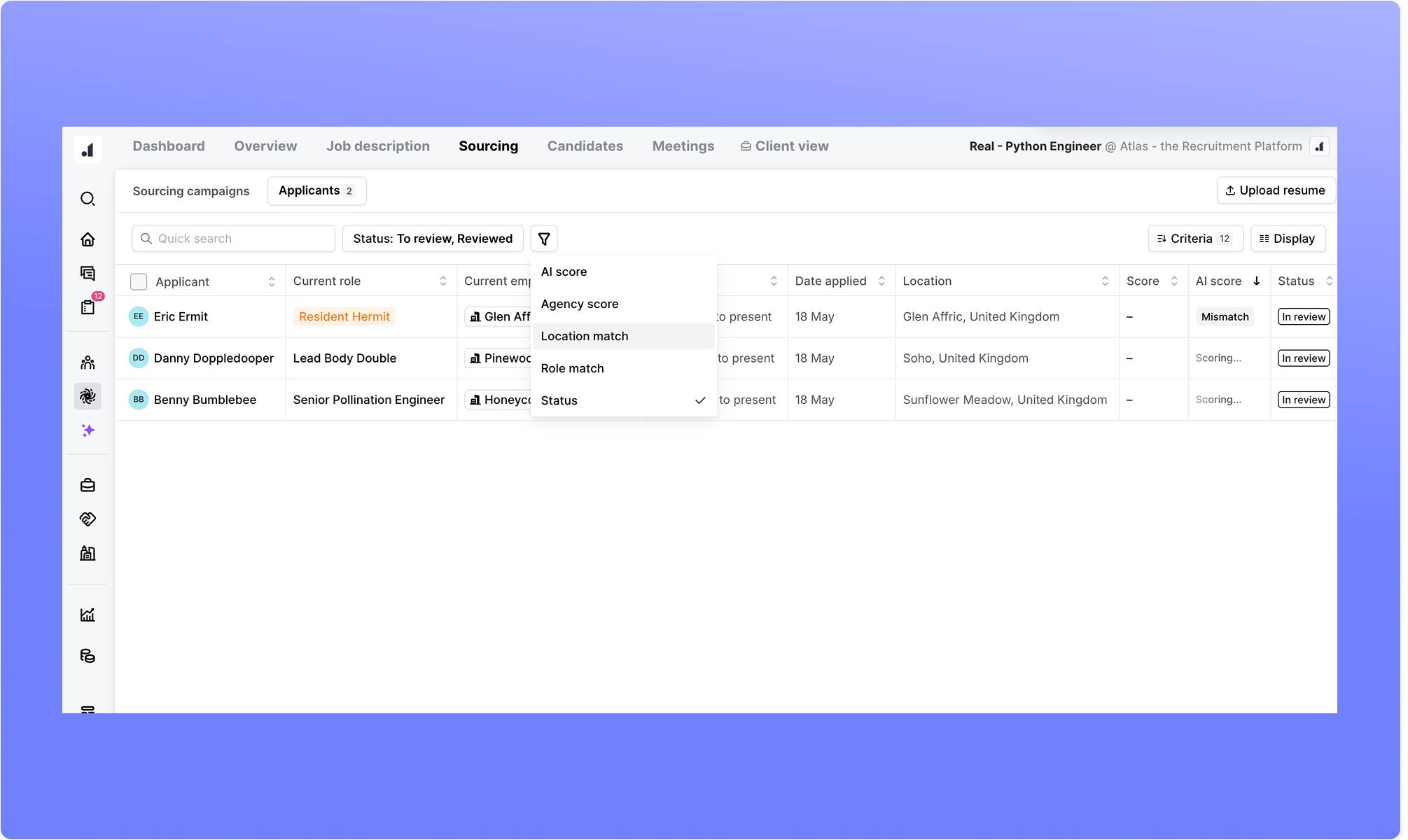
// Atlas Technology
Applicant Screening: How Recruiters Keep Their Candidate Database Clean with Atlas
Keep your candidate database clean and your team moving fast. See how Atlas's applicant screening feature triages and grades applicants automatically.
05/22/2026
8 MIN

// Recruitment Strategies
6 Ways to Keep Candidate Engagement Strong During a Chaotic Hiring Process
Chaotic hiring processes kill candidate engagement, but these 6 proven ways will keep candidates warm, informed, and committed no matter how fast things move.
05/12/2026
9 MIN